
Used Workstations for Sale from Ufficio Furniture

A workspace can drain a budget fast, especially when every person needs a reliable place to sit, work, plug in, and store daily essentials. New furniture is not the only smart path. Used workstations can help teams build a practical, polished setup while spending less and keeping good furniture in use longer.
That is why many buyers look at used workstations for sale from Ufficio Furniture when a move, expansion, renovation, or cost-conscious refresh is on the table. A pre-owned workstation can still have years of service left, and with the right planning, it can look intentional rather than pieced together.
Used does not have to mean worn out. It can mean tested, available sooner, and easier on the budget. The key is knowing what to look for before choosing a layout, finish, size, and quantity.

Used workstations can make a budget go much further
Workstations are one of the largest furniture purchases in a workplace buildout. Chairs, storage, conference pieces, and reception furniture add to the total, but workstations often set the footprint and the cost of the whole project.
Buying used can lower that cost without forcing a low-quality setup. Many commercial workstation systems were built to handle daily use for years. Metal frames, laminate surfaces, acoustic panels, storage pedestals, and privacy screens often hold up well when they have been cared for.
The savings can help in several ways:
More stations for the same budget
A growing team may be able to furnish more seats at once rather than buying in small batches.
Better quality than entry-level new furniture
A used commercial-grade workstation may perform better than a new low-cost alternative.
Faster availability
Used inventory may be ready sooner than custom-manufactured new furniture, though quantities and finishes can vary.
Less waste
Reusing furniture keeps useful materials out of landfills and reduces the need to manufacture new product.
Used workstations are also helpful for temporary spaces, project teams, satellite locations, training areas, call centers, and growing companies that expect their layout to change again. A used system can be practical now while keeping future options open.
The main tradeoff is selection. With new furniture, you can usually order exact finishes, dimensions, and quantities. With used furniture, the inventory already exists. That means the buying process starts with what is available, then works toward the closest fit.
That is not a drawback if you plan well. It simply changes the questions.
Instead of asking, “What can we design from scratch?” the better question is, “Which available workstation system gives us the best mix of size, condition, function, and value?”
The right workstation depends on the work being done
A workstation is not just a surface and a chair. It shapes focus, privacy, storage, circulation, cable access, and how the area feels during a full day of work. Before buying used workstations, it helps to separate the choices into a few common types.
Panel-based stations support privacy and structure
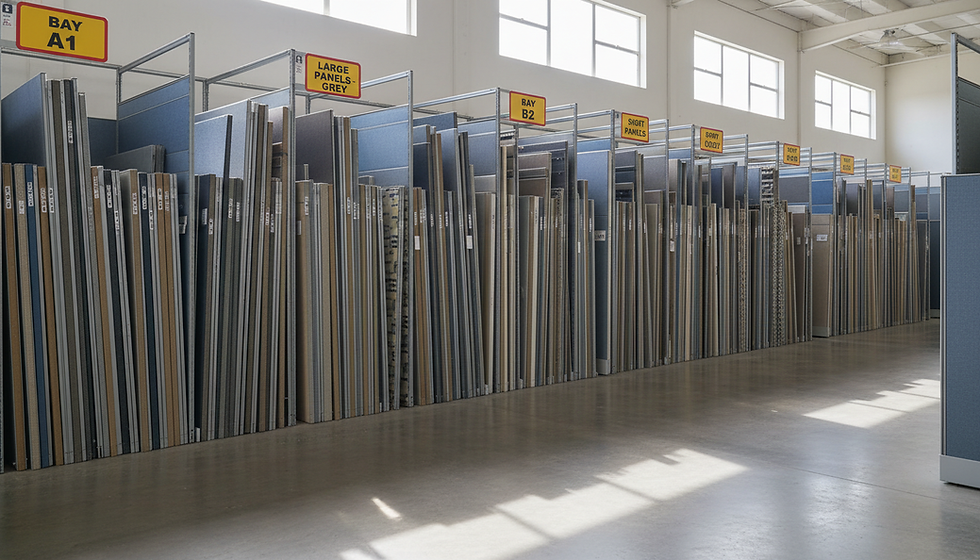
Panel systems are the classic cubicle-style setup. They usually include upright panels, worksurfaces, support brackets, storage, and electrical or cable pathways, depending on the system.
They work well when people need some visual separation or sound control. Taller panels can create a quieter feel. Lower panels keep the space more open while still defining each seat.
Panel systems are often a strong used purchase because many commercial brands designed them to be reconfigured. Parts can sometimes be removed, swapped, or rearranged. The exact flexibility depends on the brand, age, and available components.
Benching works well for dense layouts
Benching systems place multiple users along shared rows or connected spans. They usually have a cleaner, more open look than traditional cubicles. Some include dividers, modesty panels, power channels, and shared legs.
This style works well when space efficiency matters. It can also fit teams that do not need tall privacy panels. Used benching may be a good option for training rooms, temporary seating, open work areas, or shared work zones.
The important details are width, depth, power access, and whether dividers or storage are included. A benching setup without enough personal storage may need separate pedestals, shelves, or locker-style storage.
L-shaped and U-shaped stations give more surface area
Some roles need room for documents, equipment, monitors, or multiple work zones. L-shaped and U-shaped workstations provide more surface area and often feel more complete for full-time use.
These stations can use more floor space, so they need careful planning. They are often better for private offices, perimeter spaces, administrative functions, or roles with more materials.
When buying used, check whether the left-hand and right-hand returns match the intended layout. A good deal can become difficult if the orientation does not fit the floor plan.

Condition matters more than age alone
A newer workstation in poor condition is not a better buy than an older commercial-grade system that has been well maintained. Age gives only part of the story. The real test is condition, completeness, and fit.
Start with the visible surfaces. Look for deep scratches, chips, swelling, stains, cracked edging, loose laminate, dents, and mismatched finishes. Minor wear may be fine, especially on a budget. Larger damage can affect appearance and long-term use.
Next, check the structure. Workstations should feel stable after installation. Frames, legs, brackets, panels, and support hardware should be present and compatible. Missing hardware can slow down installation or limit layout options.
Electrical components need special care. If a used system includes powered panels, raceways, outlets, or data pathways, ask what is included and what must be handled by a qualified electrician or installer. Do not assume every used powered component is ready to connect as-is.
A practical inspection checklist includes:
What to check | Why it matters |
Surface condition | Sets the visual standard for the finished space |
Panel stability | Affects safety, privacy, and layout strength |
Hardware completeness | Reduces delays during installation |
Finish consistency | Helps the full layout look planned |
Power and cable access | Supports daily technology needs |
Storage condition | Drawers, locks, and slides affect usability |
Quantity available | Ensures the full team can match |
Locks and keys deserve attention too. Used pedestals and storage units may not come with working keys. That may be easy to solve, but it should be part of the buying conversation.
The best approach is to define acceptable wear before shopping. For example, a back-office project room may tolerate more cosmetic wear than a client-facing location. A temporary swing space may not need perfect finishes. A main workspace may need stricter standards.
Used furniture buying goes smoother when everyone agrees on the condition standard before reviewing options.
Measurements are where good deals succeed or fail
The most attractive used workstation is only a good choice if it fits. Layout planning should happen before purchase, not after delivery.
Start with the space itself. Measure walls, columns, windows, existing built-ins, door swings, corridors, and clear paths. Then map the required number of stations. A layout needs enough room for seating, movement, storage access, and any local code requirements that apply to the site.
Workstation dimensions vary. Common widths and depths can differ by manufacturer and system. Even a small difference can affect the full floor plan when multiplied across many stations.
Think through these planning points:
How many people need assigned seats?
How many extra seats are needed for growth?
Do users need one monitor, two monitors, or equipment space?
Is privacy more important than openness?
Will each station need storage?
Where will power and data come from?
Can installers access elevators, loading areas, and doorways?
Will the layout need to change later?
The answers guide the product choice.
A dense benching layout may seat more people, but it might not provide enough privacy. A panel system may feel better for focus, but it can use more space. Larger L-shaped stations may improve comfort, but they reduce headcount in the same footprint.
There is no single best layout. The best layout is the one that supports the work, fits the room, and can be installed without awkward compromises.

Buying from a furniture source can simplify the process
Used workstation projects involve more than picking a product photo. The buyer needs to confirm the count, dimensions, finish, condition, components, delivery needs, and installation plan. A knowledgeable furniture source can make those steps much easier.
Ufficio Furniture offers a place to start when searching for used workstations, especially for buyers who want options beyond random one-off listings. The value is not only in the furniture itself. It is also in the ability to compare available systems, ask practical questions, and understand what the purchase includes.
When reviewing used workstations for sale, ask clear questions:
What quantities are currently available?
Are the stations sold as complete sets or separate parts?
What are the exact dimensions?
Are storage pedestals, dividers, panels, or power components included?
What condition should the buyer expect?
Are matching add-on parts available?
Can the layout be reconfigured?
What delivery or installation support is available?
Are there photos of the actual inventory?
Photos are useful, but they should not replace measurements and component details. A workstation system can look complete in a photo while still missing key brackets, supports, trim pieces, or storage parts.
It also helps to ask how the product will arrive. Workstations often ship or move in parts. Panels, tops, legs, supports, and storage pieces may need to be assembled on-site. That means the delivery path matters. Stairs, elevators, dock access, hallway width, and parking can all affect the final plan.
For nationwide buyers, coordination becomes even more important. A clear inventory list, accurate dimensions, and realistic delivery expectations help avoid surprises when the furniture reaches the site.
A good used workstation purchase should feel organized from the start. The buyer should know what is included, what is not included, and what needs to happen before installation day.
Style still counts even when the furniture is used
Cost savings should not mean a space feels random. Used workstations can look clean and consistent when finish, scale, and layout are handled with care.
Start with color. Neutral workstation finishes, such as white, gray, maple, walnut, or charcoal tones, are often easier to place with existing furniture. Mixed finishes can work, but the mix should look intentional. Too many panel colors, top finishes, and storage styles can make the layout feel patched together.
Next, consider panel height. Tall panels create privacy and a more enclosed feel. Low panels create openness and better sight lines. Mixing panel heights can work in zones, but a full area usually looks better when the height is consistent.
Storage also changes the look. Matching pedestals or storage units can make used stations feel more complete. Mismatched storage may still function well, but it can affect the overall impression.
Small refreshes can help used workstations feel newer:
Replace worn edge trim where possible.
Clean laminate and metal surfaces before installation.
Use matching monitor arms or accessories.
Add consistent task lighting where needed.
Keep cable routing neat from day one.
Pair stations with chairs in a consistent color family.
The goal is not perfection. The goal is a space that feels planned, clean, and ready to use.

A smart used workstation purchase starts with a clear plan
Used workstations can be one of the most practical furniture choices for a growing or changing workspace. They can reduce costs, shorten timelines, and give commercial-grade furniture a second life. The best results come from matching the available inventory to the real needs of the space.
Before buying, define the station count, layout, privacy needs, storage requirements, condition standard, and installation details. Then compare the available options against that plan.
Ufficio Furniture can be a useful source for finding used workstations that fit those requirements, but the same rule applies to any used furniture purchase: measure carefully, ask what is included, and make sure the system supports the way the space will actually be used.
A good workstation is not just furniture. It is the place where daily work happens. Choose one that fits the room, the budget, and the people who will use it every day.
Our Address: 1215 Meyerside Drive, Unit 7 Mississauga, ON L5T 1H3
Call us at:
Store Number: 905-795-2506(10am-7pm)
#1) [647-898-8918]
#2) [647-955-1206]
Business Hour:
MONDAY: 10am-7pm
TUESDAY: 10am-7pm
WEDNESDAY: 10am-7pm
THURSDAY: 10am-7pm
FRIDAY: 10am-7pm
SATURDAY: 10am-7pm
SUNDAY: 11am-6pm
No appointments required. Just walk in during the business hours Mississauga.
Same day or next day delivery available.


Comments